In 2024, Milwaukee County lost 450 people to overdose. Black residents were 42% of those deaths but only 27% of the county’s population. That is nearly double the fatal overdose rate of White residents, even though Black and White people use drugs at about the same rates. That gap is a result of which demographic has been policed, punished, and left without significant care. The same pattern shows up in cities and towns across the Midwest. Overall overdose deaths have started to fall in the region, and nationally, but Black and Brown communities are not experiencing the same relief.
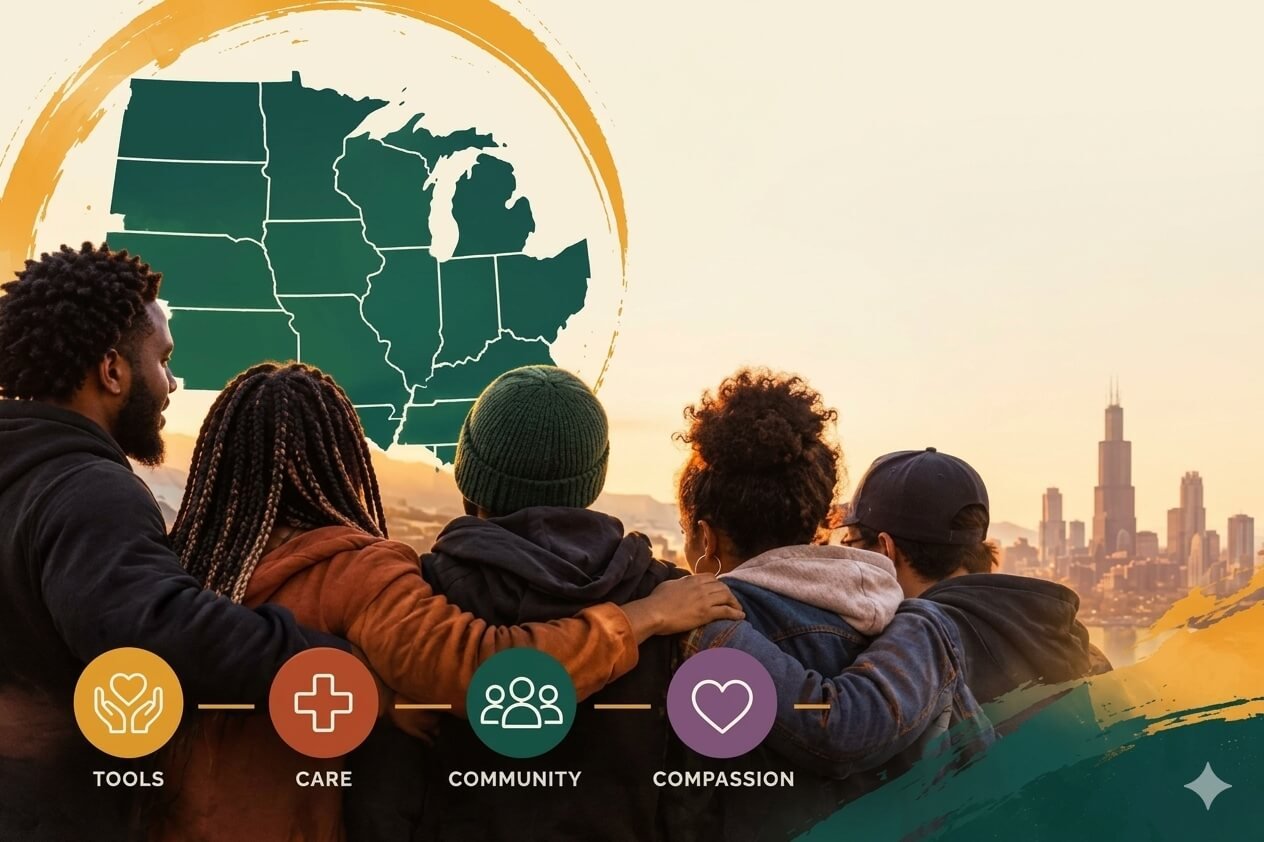
The Midwest Regional Black and Brown Harm Reduction Network exists to close that gap. It brings together Black- and Brown-led organizations across Midwest states to replace punishment with care. To understand why this work is urgent, one must look at the devastating impact that the War on Drugs and mass incarceration has inflicted on Black and Brown communities.
A war on drugs that became a war on Black communities
For 50 years, the United States answered drug use with handcuffs instead of health care or counseling. The burden of that choice fell hardest on Black and Brown neighborhoods.
The modern war on drugs began in 1971. It escalated in 1986, when the Anti-Drug Abuse Act punished crack cocaine 100 times more harshly than powder cocaine. The two are the same drug. But crack was associated with communities of color, and powder with White ones. Five grams of crack brought the same five-year mandatory minimum as 500 grams of powder. Congress narrowed the gap to18 to 1 in 2010, but it has never been fully closed.
Enforcement followed the same pattern. Police concentrated drug arrests in Black and Brown neighborhoods, even though people of every race use and sell drugs at similar rates. Marijuana shows this most clearly. Black people are 3.64 times more likely than White people to be arrested for marijuana possession. In 10 states, the gap was more than 5-to-1.
The message to Black communities was simple: drug use among your people is a crime to be punished. Among others, it was treated as a health problem or ignored. That double standard built the foundation for mass incarceration.
Mass incarceration: the damage that outlasts a sentence
The U.S. prison population is nearly six times larger than it was 50 years ago. Black Americans are imprisoned at 5 times the rate of White Americans, and 1 in 5 Black men born in 2001 can expect to go to prison in their lifetime.
The Midwest is among the worst offenders. The Sentencing Project found that the upper Midwest and Northeast show the widest racial gaps in their prisons. Wisconsin leads the nation: 1 in 36 Black adults is in prison, and Black residents are 42% of the prison population but only 6% of the state, as reported by Wisconsin Watch. That is a disparity of nearly 12-to-1, more than double the national gap.
A drug conviction can shatter families and communities:
- Families broken apart. Children lose parents, and households lose income, often for extended periods.
- Jobs and housing closed off. A criminal record makes it harder to rent an apartment, pass a background check, or qualify for some public benefits.
- Voices silenced. Felony disenfranchisement laws strip voting rights from hundreds of thousands of Black and Brown citizens, weakening whole communities’ political power.
- Health put at risk. People leaving prison face a sharply higher risk of fatal overdose in the first weeks after release, when their tolerance has dropped, and support is scarce.
Mass incarceration also teaches people to fear the systems that are supposed to help and protect them, adding to the friction with law enforcement. To avoid interaction with police, individuals often use alone and hide their use from doctors or family members. Criminalization hasn’t stopped drug use. It just makes drug use deadlier.
The overdose crisis now falls hardest on Black and Brown Midwesterners
Across the country, overdose deaths are finally falling, but the racial gap has not closed. Black Americans saw a 29% drop in overdose deaths between 2023 and 2024. Even so, their death rate stayed more than 1.5 times the national average, according to a 2026 study from UC San Diego. Deaths involving cocaine and xylazine, a sedative now mixed into the drug supply, remain especially high among Black Americans.
Milwaukee shows what that looks like on the ground: Black residents dying of overdose at nearly twice the rate of White residents. Nationally, many of those lost are older Black men who survived decades of the drug war, only to meet a fentanyl-contaminated supply with little access to treatment, naloxone or test strips.
This is the drug war’s long shadow. Communities that were policed for decades were never given the clinics, outreach workers and recovery homes that wealthier, whiter areas received. When fentanyl arrived, that infrastructure wasn’t available to help curb its use and impact, and people died because of it.
Why the response must be led by Black and Brown communities
We know harm reduction works. Naloxone reverses overdoses. Fentanyl test strips let people check their supply. Syringe services prevent HIV and hepatitis C and connect people to treatment. But these tools only save lives if people trust them.
After decades of criminalization, that trust has to be earned. A Black man who has spent years in prison has little reason to believe a program tied to police or courts is there to help him. Mainstream harm reduction has too often been designed for White, suburban drug users and funded through large organizations far from the neighborhoods hit hardest.
The Midwest Regional Black and Brown Harm Reduction Network strongly believes harm reduction without racial justice is destined to failure. The people best able to reach Black and Brown communities are the organizations already rooted in them, led by people who share their history and, often, their lived experience with drug use, recovery, and incarceration.
Yet those groups are usually the smallest and least funded. Working alone, they compete for scraps. Together, they can build the power to match the scale of a regional crisis.
What the Network does
The Network began in Milwaukee, where eight founding organizations came together around one belief: no one has to do this life-saving work alone. Among them is Tahira Malik, CEO and founder of Samad’s House, who grew a single sober living home into a network of homes and a behavioral health clinic. She saw that even as overdose numbers improved overall, the disparity in Black and Brown communities stayed stark.
The Network embraces life-saving principles, such as:
- Resource sharing and capacity building. Members pool and redistribute naloxone and fentanyl test strips, and offer training, tools, and peer mentorship to emerging Black- and Brown-led groups.
- Narrative change. The Network shifts the public story away from criminalization, centering lived experience and community wisdom in campaigns across the region.
- Data sovereignty. Communities own their data. The Network tracks its impact ethically and rejects research that takes from communities without giving back.
- Care for the caregivers. Frontline workers get healing spaces and trauma-informed support, because this work is exhausting and often traumatic.
Just as important is what the Network refuses to do. We won’t partner with punitive or surveillance-based systems. After 50 years in which drug policy equated to police, courts and prisons for Black and Brown communities, this is a new day with a commitment to non-carceral care, and building trust as harm reduction saves lives.
Care, not punishment
The drug war promised safer communities. Instead, it locked up generations of Black men and women, broke apart families and left neighborhoods without the care they needed when fentanyl arrived. The overdose gap in places like Milwaukee is an example of the toxic environment it has created.
The Midwest Regional Black and Brown Harm Reduction Network is building something different: a region where Black and Brown communities are resourced, respected, and self-determining in protecting their own lives. Where care comes first. Where every person who uses drugs has the chance to survive and thrive.
Our Network is growing. Organizations, funders, health departments, and neighbors can all play a part. Join us.


